The myth of a twice-promised land is used (among other things) to question Israel’s legitimacy.
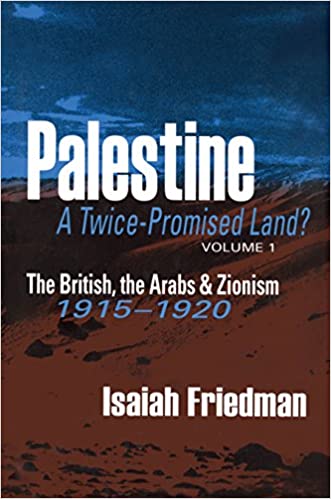
Ben Gurion University history professor Isaiah Friedman published a book in the year 2000 tackling the myth that Israel was promised by the British to both the Jews and the Arabs. He hopes that clarifying the truth behind the myth may “help create a better climate of international understanding” regarding Jewish-Arab relations.
The myth promoted by British historian Arnold J. Toynbee still holds sway to this day. For example, in 2003, a group of Palestinian Arabs requested an apology from the British for the Balfour Declaration, issued two years after the supposed promise of Palestine to them. In 2016, an Israeli Jewish woman published a memoir she entitled A Land Twice Promised. Therefore a review of what Friedman discovered when he examined the archive materials after they were made available to researchers in London is relevant to us today.


The Arabs base their claim to Palestine upon a letter written by Sir Henry McMahan, High Commissioner of Britain in Egypt to King Hussein, Sharif of Mecca and head of the Arab troops involved in the Arab Revolt against the Ottomans in the Hejaz, now Saudi Arabia. However, according to Friedman’s research, there are two major points of misunderstanding. These are:
- The McMahan letter of 1915 did not include the land west of the Jordan River in the promise of independence.
- This was not a one-sided promise without conditions. Independence would be dependent upon the active participation of the Arab tribes in their own overthrowing of the Ottomans in their own regions. In fact, the Arabs in what is now Lebanon, Syria, Jordan and Israel fought on the side of the Ottomans and the Germans and not against them. They were not enthusiastic to replace the Turks with the British and the French. Only the tribes in the Hejaz fought on the side of Britain. Because of this, Friedman writes, it was “the Arabs who remained in debt, not the British” and the Hejaz tribe was rewarded as promised.
Toynbee was personally involved in the events surrounding Palestine at the time. In 1915, he worked at the intelligence office of the British Foreign Office and in 1919 he was a delegate at the Paris Peace Conference. This gives him authority when he writes about the McMahan letter. But Friedman argues that Toynbee did not consider the entire context of communications and meetings that were taking place during the time period between 1915 and 1920, material to which he, Friedman, only accessed in full in the late 1980s. Furthermore, Friedman asks why Toynbee, in a 1918 memorandum:
recommended that Britain assume the role of trustee of the Jewish National Home, rather than hand Palestine to the Arabs, if he thought that it was included in the boundaries of Arab independence?
Changing Attitudes?
It appears that Toynbee initially supported the Jewish return to the Land of Israel and later changed his mind. This mirrors Arab sentiments as well, since initial reactions of some Arab leaders and intellectuals to the influx of Jews to the region was regarded positively. In fact, as reported to me by Emeritus History Professor Amatzia Baram, they welcomed the Jews to Palestine and regarded the Jews as coming home:
how is one to explain the fact that Ahmed Lutfi al-Sayyid, President of Cairo University was an official guest at the inauguration of the Hebrew University of Jerusalem in 1925? Al-Sayyid, in fact, wrote a highly complimentary and congratulatory letter to the university. Even earlier, in March 1918, in his al-Qibla magazine, Sharif Hussein of Mecca congratulated the Jews for returning to the Middle East.
According to an American Egyptian blogger, Egypt under King Farouk was very receptive to the idea of a Jewish state and had warm relations with Chaim Weitzmann. Egypt even banned an anti-Zionist publication, and pro-Zionist publications and activities operated freely until the 1940s. As opposed to many places around the world, the port at Alexandria was open to Jewish refugees from Nazi Germany. That later changed when antisemitism raised its head, explains Middle Eastern politics expert Samuel Tadros, partly as a way to shift attention away from the failures of the leadership by blaming the Jews and partly due to the influence of Nazi propaganda among the Muslim Brotherhood. Antisemitism later turned into anti-Zionism.
Friedman’s Study of Primary Sources
Friedman was able to reach his conclusions as a result of access to primary sources that only were opened to researchers in the 1960s and to which he had availed himself in the 1980s. It seems nobody reported on these sources before him. Most importantly, he had access to the original McMahan letter, its translation into Arabic,
— which was thought to have been lost — as well as its retranslation into English made at the British Residency in Cairo in November 1919.
By examining these documents, misunderstandings became clear when comparing the Arabic term used to refer to certain districts and the way the term was translated back into English, giving an entirely different meaning.
Also, by going through the actual correspondance, memorandi and personal notes written by the persons active and influential at the time, Friedman was able to piece together a complex web of interactions that characterized the attitudes and intentions of the time.
His conclusion: Palestine was not twice-promised. Not by a long shot. It is time we argue that point whenever anyone raises it in our presence. This brief recap of the main points of Friedman’s research should provide the ammunition required.
Arnold J. Toynbee Isaiah Friedman twice-promised land
Last modified: July 13, 2021