Sinokrot Holdings is a very successful family business in the Palestinian Authority (PA). A case study examining the reasons for its success was published in the first volume of a new economics and accounting journal. The description of success in view of very difficult conditions for entrepreneurship would have been much more valuable if they had told the truth about the complex challenges facing small businesses in the PA. However, in view of the recent murder of an activist critical of the PA leadership it is quite understandable why the company directors would not want anything negative to be written about the impact of PA corruption on their business. Instead, they direct their frustration and ire at Israel. Were the authors to discuss legitimate problems concerning Israel, it would have had a place in an academic journal. However, their inclusion of blatant propaganda lies against Israel in no way contributes to the article and, in fact, calls into question the integrity of the new academic journal as a whole. Given space considerations, I can only relate to a few points from the article.
Sinokrot Holdings in a Hostile Environment?
It is understood that the PA environment is not the most conducive to small businesses. For example, when the PA anticipated receiving lower American funds because of the Taylor Force Act, they passed the losses on to the car dealerships by increasing import duties and endangering these businesses. It would be interesting to learn how Sinokrot Holdings deals with such events but there was no word of difficulties of this nature. Instead, the authors repeat unsubstantiated propaganda points that can be found at anti-semitic Apartheid Week events on Western university campuses, such as:
Businesses in Palestine function under crucial adverse conditions such as the Israeli closure policy, movement restrictions, and round-the-clock curfews. Palestinians are threatened with extreme poverty due to the separation wall’s construction (Abu Ras & Mohamed, 2018; UN, 2004).
There are closures, restrictions of movement and curfews when there is intelligence telling of an impending terrorist attack. These are not routine. In fact, even B’Tselem, the extreme left anti-Zionist NGO admits on their website that most checkpoints are unmanned and everyone passes by unhindered even at the rare checkpoint with a permanent presence of soldiers — unless, of course, there is intelligence of an impending terrorist attack!
The separation wall was constructed after incessant terrorist attacks over the border during the second intifada in 2000 and were there no terrorist attacks, there would be no wall. To ignore the context of terror is to mislead readers who may not know this history. Furthermore, the wall did not threaten to cause “extreme poverty”; the terror situation meant that the number of Palestinian workers employed in Israel (at double the salaries to be had in the PA) was reduced by at least half, thereby reducing many family incomes. Again, without needing to protect herself against suicide terrorists, Palestinian workers would still be moving freely across the border to work in Israel.
The following paragraph is highly inaccurate and deceptive:
Although the Palestinian economy enjoyed substantial growth following the 1993-1994 Oslo peace accords between the Israelis and the Palestinians and the Palestinian authority’s establishments, this growth period masked deep-seated structural imbalances and weaknesses inherited from the occupation period.
First of all, the “West Bank” economy rose and fell a number of times between 1968 and 1999 (as well as afterward). The low points occurred in response to Israel’s closures and reduced employment of Palestinians because of the two intifadas and the loss of jobs of Palestinians living in Kuwait after they put their support behind Sadam Hussein during the Gulf War. Until then, the remittences of their earnings to family living in Judea & Samaria had been a substantial contribution to the economy.
Secondly, the “deep-seated structural imbalances and weaknesses” were not “inherited” from the Israeli so-called occupation period but in fact from the Jordanian occupation period of 1948-1967, a period of time not studied sufficiently and totally ignored by contemporary historians. It is almost as if researchers believe nothing of significance occurred in Judea & Samaria before the Jews won the land back. In fact, no industry was initiated, no universities established in the “West Bank” under Jordan. According to the few studies available (e.g., Baster, 1955; Sela, 2019; Schein, 2013; Taher, 1979), the great Palestinian Naqba can perhaps be said to be the capture and illegal annexation of what Jordan called The West Bank. Schein writes:
Mazur notes that in 1950 there was a ‘great gap in modernization’ between the residents of the West Bank and the East Bank. He writes, ‘The Palestinian Arabs were more urban, more cosmopolitan, and more educated than the Arabs of Transjordan’ (17). This suggests that in 1950 the per capita income in the West Bank was higher than in the East Bank, but by 1967 this had been reversed.
This observation is repeated in all the articles linked to above. The reasons given are not only the greater education of the Arabs living west of the Jordan River but also because they had had easy access to Haifa and Ashdod ports and to much of their more arable land in what ended up on the Israeli side of the armistace line in 1948. It can not even be imagined how the Arabs living in Judea & Samaria would have fared had the Arab states not tried to wipe out the newly declared State of Israel in 1948. This is an aspect I have not seen raised in any discussion of the Naqba.
Thus, economic growth in the Jordanian occupied West Bank declined after Jordan (and Egypt and Syria) unsuccessfully tried to destroy the Jewish state in 1948 and lasted until 1967, in what came to be known as the 7-Day War, when Israel regained control of Judea & Samaria (and the Golan, Gaza and the Sinai Peninsula). In fact, after the 7-Day War, Arabs from the formerly Jordan-occupied territories found employment in Israel and initially there were no border checkpoints. Movement was free in both directions, with Arabs working in Israel and Israelis shopping in Arab towns. The “West Bank” saw a steadily increasing Gross Domestic Product (GDP) until suicide terror attacks increased and Israel had to close the border to protect her citizens. In this way, the Arabs of Judea and Samaria only succeeded in losing the significant means of economic sustenance they had enjoyed when in cooperation with the Jewish state.
The Phony Map: “Palestinian” Loss of Land
I must admit that I was surprised to see this fake map, that is generally used for propaganda purposes, appear in an academic journal given that the articles are supposed to have undergone expert peer review. Any expert should know that this map tells a lie. For a comprehensive treatment of the problems with the map, see the article by former director for foreign policy, Israeli National Security Council Shany Mor.
In brief, let me just mention that what they are referring to in green as “Palestinian” land in 1946 is merely state land under the Ottoman Empire and then under the British Mandate. There never was a sovereign Palestine and therefore there was no way that “Palestine” could control public lands.Furthermore, a distinction needs to be made between publicly owned and privately owned land. The white sections indicate land privately owned by Jews, thereby confounding public and private lands. This map series, then, tries to argue that the Jews stole land from Arabs, but that is simply not true.
The 1947 map shows what the Palestinian Arabs could have controlled if they had accepted the UN Partition Play. They did not. The 1949-1967 map shows the Gaza Strip that was occupied by Egypt and the so-called West Bank that was occupied by Jordan. Again, there was no Palestinian controlled public land. The 2016 map shows areas under the control of the Oslo-created Palestinian Authority in a contract signed by Yasser Arafat, Shimon Peres and Yitzhak Rabin in 1993. The correct understanding of the situation would be that from having absolutely no public lands ever, there is now a Palestinian political entity that has control over land. In other words, “Palestine” did not lose land, they acquired control over land they never had.
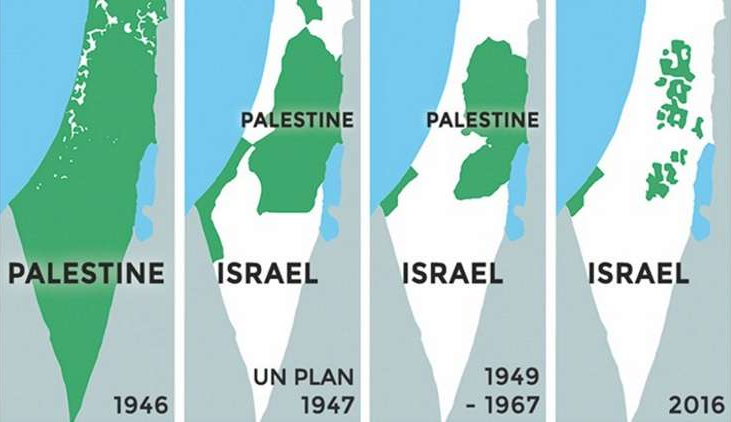
Figure 1. Palestinian loss of land (1946 to 2016) Source: Bailey, 2016; Kay, 2018)
The Sinokrot Success Story
The authors write:
Established in 1982, Sinokrot Global Group (SGG) managed to grow from a small confectionery company known as Sinokrot Food Company to the largest family-owned business group in Palestine. Located inside the Industrial Zone near Ramallah’s city in the West Bank, they started their business by manufacturing several confectioneries, including nougats, wafers, and chocolates. SGG, which is currently one of the leading organizations in the Middle East, chose to expand by diversifying its business vertically and horizontally into sectors or Strategic Business Units (SBUs), as shown in Figure 2.
Further, the rapid growth that SGG experienced put them under enormous pressure to expand their social responsibility, not only toward the employees and their families but also toward the Palestinian community. SGG has 3500 employees working in 400 outlets who provide 2,700 family members in 70 cities, villages, and refugee camps (Khoyira, 2008).
This is certainly commendable and I am sure that each one of those 3500 employees are glad for the work. The authors present this case as a role model for family businesses setting up in other “challenging conditions”, such as in Afghanistan, Iraq and Nigeria:
Solid relationships with the government, institutions, NGOs and international groups ease some of the company’s barriers and threats. SGG takes an active role in formulating economic laws and regulations in cooperation with local government.
What the authors euphemistically call “solid relationships with the government….” is actually a corrupt and unacceptable relationship in a corrupt government. The CEO of Sinokrot Holdings was a Minister of National Economy in the government of the PA and says so on the company website. As such, he is a member of the elite leadership against which protests are becoming more frequent on the part of the PA citizens who are tired of being under their thumb, lied to, and stolen from (much of the humanitarian and infrastructure funds donated by foreign governments go into private pockets and do not improve the lives of the people). The “active role in formulating laws and regulations” for businesses is blatant manipulation of their power and connections. Do the expert peer reviewers of this article support that kind of behaviour on the part of family businesses attempting to make it under “challenging conditions”?
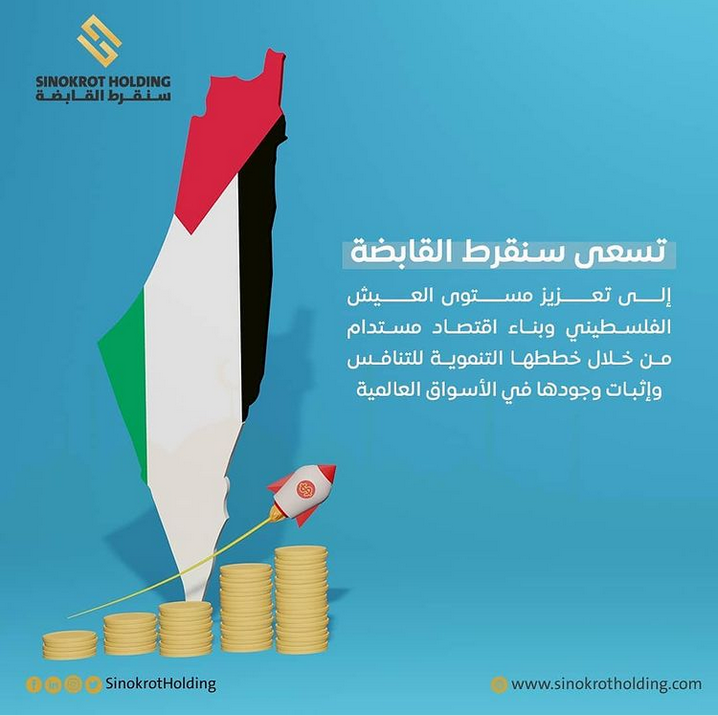
Feature Image Credit: Screenshot of Sinokrot Holdings Instagram Account image. Note how “Palestine” is all of Israel.
academic distortions about Israel anti-Israel propaganda Palestinian economy Sinokrot
Last modified: December 11, 2025