Do you know how easy it was to get Palestinian refugee status from UNRWA in 1948? All it took was living in the British Mandate for Palestine for two years. Here is a quote from an article published in the Palestine-Israel Journal in 1995.
A Palestine refugee is a person whose normal residence was Palestine for a minimum of two years preceding the conflict in 1948, and who, as a result of the conflict, lost both his home and his means of livelihood and took refuge in one of the countries where UNRWA provides relief [Jordan, Lebanon, Syria, West Bank, Gaza]. (UNRWA, UNRWA 1950-1990: Serving Palestine Refugees. Vienna: April 1990). [We’ll just ignore that fact that this writer is calling the West Bank and Gaza countries.]
I wonder, when considering an individual’s application for refugee status according to this definition, how seriously that person’s situation was examined:
(1) Let us suppose that the two-year residency condition was checked out and some applicants were, in fact, rejected because they were living on the land for a shorter period of time — Do I believe that? Let’s say that I take it with a grain of salt.
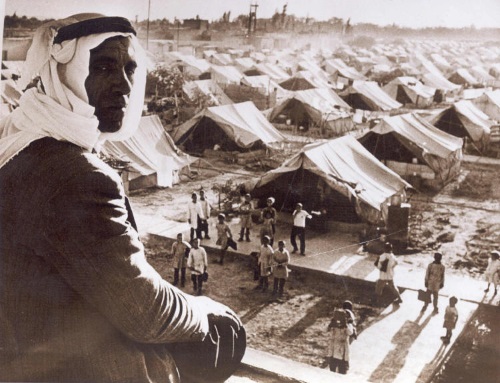
Jaramana Refugee Camp for “Palestinian” Refugees, Damascus, Syria – 1948 [Public domain via Wikimedia Commons]
(3) Did the applicant “take refuge” in one of: Jordan, Lebanon, Syria, the West Bank or Gaza? What if, just a short two, or even five, years earlier, the person or family had actually migrated from Jordan, Lebanon, or Syria? Does not “taking refuge” in these countries, then, merely constitute returning home? Or would someone originally from what became Jordan deliberately take refuge in Lebanon in order to achieve refugee status? Or someone from Egypt, since Egypt is not one of the countries covered by UNRWA refugee services? What would make someone do that rather than go back to where they came from before migrating to the Palestinian Mandate?
I don’t know if the statistics are available regarding the questions above. For those awarded Palestinian refugee status in 1948: are there data for the lengths of time they resided in the Palestinian mandatory territories? Do we know how many owned or rented their homes versus those who were illegal squatters? Do we know the countries or regions of origin before migrating to the British Mandate of Palestine and how many came from each one? Do we know how many were truly long-term residents?
If any of those who acquired Palestinian refugee status were migrants from Egypt, Syria, Saudi Arabia and other Arab countries, why did they not go back and rebuild their lives in their places of origin? In fact, Fathi Hammad, Interior Minister of Gaza, said in 2012 that half of the Palestinians are Egyptian and the other half are Saudi Arabian.
All it took was living on land that later became Israel for a mere two years to have the privilege of spending the rest of your life, and your children’s lives and their children’s lives, in refugee camps. I don’t understand the attraction.
More than that, however, I wonder how people can overlook the inconsistency of claiming long-term or even indigenous status for the “Palestinian” Arabs with the UN offer of refugee status to those who had been there a mere 2 years.
* * * * *
Slightly modified version of post I originally published on Times of Israel Blogs.
British Mandate of Palestine origin of today's Palestinian refugees Palestinain refugee status
Last modified: October 11, 2015