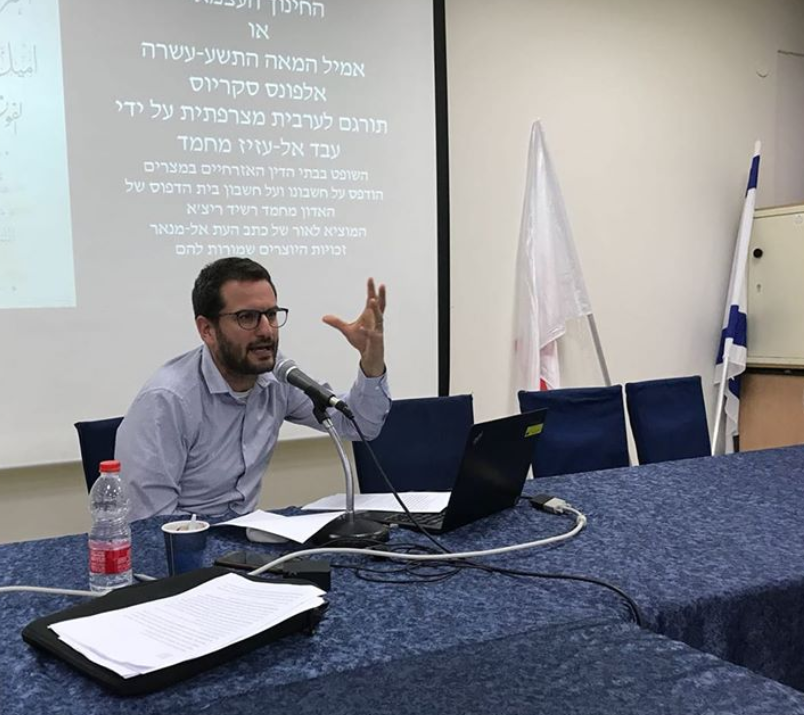
There is a new boy on the block. He is a new generation New Historian who takes the post-Zionist revisionist history of Israel to the next stage of evolution. And, according to textbook analyst Dr. Sandra Alfonsi, he is dangerous.
His name is Dr. Yoni Furas. He completed his PhD in 2015 at Oxford and presently he is a post-doctoral fellow at Haifa University in the Department of Middle Eastern and Islamic Studies. That means he is young and up-and-coming, a New New Historian.
In 2017 he published a book in Hebrew based upon his Master thesis; it is soon to be released in English. Already this year he has published two articles. The one I want to discuss here is called “We the Semites: Reading ancient history in mandate Palestine“. It appears in Contemporary Levant, a British journal and comprises a slightly modified chapter from his doctoral thesis.
This is how he describes his research interest on his Linkedin profile:
I examine the evolution process of both national movements, the Palestinian and the Zionist, as inseparable from one another and as evolving through a constant dialogue, conscious or unconscious, with the national other.
Furas is saying that Arab Palestinian and Zionist national developments are equivalent, suggesting that they arose simultaneously (in ‘constant dialogue’ implies this) and developed in relation to one another. And while the Palestinian movement is indeed inseparable from the Zionist, the reverse is not true at all. This would be laughable if it was not so appalling. This New New Historian claims that Zionism, which has a history of thousands of years, developed vis-a-vis Palestinian nationalism that History Professor Emeritus Amatzia Baram told me only began in a meaningful way in the minds of some Arab leaders in Mandatory Palestine around the years 1920-1924 or so.
Baram went on:
Until 1918, all the Muslims in Palestine saw themselves as Ottoman Muslims, subjects of the Caliph-Sultan in Istanbul. Culturally, not politically, they saw themselves as Arabs. In October 1918, when General Allenby gave Damascus to Prince Faisal of Mecca, the intellectual class in Palestine opted for Syria. This began to die out in July 1920 when Prince Faisal was driven out by the French army. Soon afterward, the politicians of Damascus lost any interest in Mandatory Palestine. This was the historical moment when Palestinian nationalism was born! On the Jewish side, religious yearning for a return to the Land of Israel was predominant for about two millennia. The secular-political trend that grew out of those religious yearnings began in the middle of the 19th century.
In Furas’ one ‘mission statement’, then, we have the kernel of what he is promoting. How many readers will even notice that Furas is wiping out millenia of Jewish peoplehood with deft and deceptive use of language?
Introducing the Chronotope
“We the Semites” was apparently prepared for a special issue of the journal that introduces the term, chronotope, to historical analysis. This term is borrowed from Russian philosopher-literary scholar, Mikhail Bakhtin. Furas never defines chronotope so we need to rely on what is written in other articles in this volume. For example, in a piece on Beirut the author writes that,
Bakhtin’s chronotope allows for an appreciation of the ways in which meaning is produced at the juncture of space and time, and the crucial role of narratives in this respect.
In another paper in the journal:
Thus, Bakhtin’s analysis of novelistic chronotopes throughout history can be grasped as historically variable structures of narrative time–space that predetermine the kinds of experience the novel’s heroes can undergo.
While I could not see how the use of chronotope added anything to their analyses, these definitions are consistent with how Furas uses the term. And if you find reading these two definitions convoluted, try reading an entire paper written in like style!
Furas examines two ‘chronotopes’. The first, to which he devotes the great bulk of his article, concerns the racial designation of Arabs and Jews as Semites. It is not clear to me how that qualifies as a chronotope, but it seems his main point is to suggest commonalities between Palestinian Arab nationalism and Jewish nationalism given that both have their origins as ancient Semitic peoples. This provides the foundation upon which to examine his second chronotope: the juncture of (narrative) space and time that took place during the Israelite invasion and vanquishing of Canaan. Furas sees this particular event in the ancient history of the Jews as pivotal for the differential developments of Palestinian and Israeli nationalisms and he calls this a contested chronotope.
Furas never tells the reader why, of all the topics likely covered in the history texts of Mandatory Palestine, he chose these two. He also never tells us how much space either of these subjects actually occupied within the curricula. That means that there is absolutely no context for his ‘analysis’.
I will concern myself here only with his treatment of the story of Canaan.
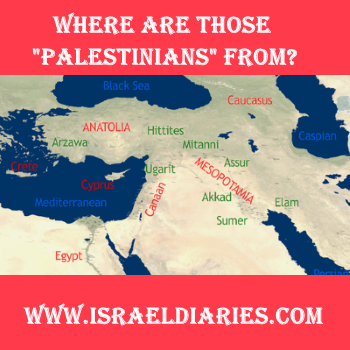
Canaan for the New New Historian
There is no debate around the biblical account of the Canaan story but Furas artfully misleads the reader who is not paying attention:
Pre-conflict Arab sources remained loyal to the traditional biblical narrative, in which the conquest of Palestine by the Hebrews was a triumph ‘under the grace of God’ (Dibs 1895, pp. 1, 189–90, 206–7, see also Al-Bustānī et al. 1900, pp. 662–63). [my emphasis] (page 8)
Of course, there was no Palestine during biblical times. I suggest that such a sentence is an example of subliminal messaging, a term generally applied to marketing but which should perhaps be explored in academia as well.
Furas argues that the Canaan story provided the Zionists with a tale of heroism and courage and provided the Palestinians with a warning and he claims that under the Mandate “Palestinian historians” saw the event as
… an ancient clash of civilisations and identif[ied] themselves with the Canaanites. (page 8)
The next paragraph purports to provide examples from Palestinian texts that support this statement but he begins with this sentence:
In most textbooks the identification of the Hebrews and Canaanites with the modern Jews and Arabs in Palestine seems clear. [my emphasis] (page 8)
He then cites eight texts but he does not provide even one example in which an author actually made a statement linking the ancient story of Canaan to the contemporary ‘colonization’ by the Jews.
Furthermore, for the Zionists, Furas claims, it was a model for future behavior. He seems to justify this suggestion on the fact that:
Since the eighteenth century, the biblical story of the Hebrews’ colonisation of Canaan and subsequent annihilation of the Canaanites had been used in Europe for the critique or apologetics of colonial expansion (Shavit and Reinharz 2009, pp. 277–278, Ilani 2016, pp. 81–105).
As if European Christian use of the Canaan story had any bearing on Jewish understanding of our own history or instructions for future behaviour.
Our New New Historian is not very exact here. Ilany (2012, 2018) writes that 17th Century Europeans justified their conquest of the Americas by referring to the conquest of Canaan by the Israelites. However, by the 18th Century, the Europeans began to regard the Israelites as barbarous savages in order to “defrock the Jews of their chosen people status” (Ilany, 2018, p 71). Furas mentions anti-Semitism in his paper in another context but what Furas leaves out is that Ilany also writes about how the Germans, during the Enlightenment, drew inspiration from the Canaan story:
The focal point of the debate [surrounding the conquest of Canaan] in this context shifted from the question of a religious war’s legitimacy to a question regarding historical rights to a territory and the link between a people and a land. [Ilany, 2012 p 460]
This is relevant to history education in mandatory Palestine because the educators themselves received their own higher education in Europe. However, did Zionist educators in the Mandate actually teach their pupils that the story of Joshua in Canaan, mass-murder and all, was a model for the aliyah to Palestine? Furas claims this is so when he writes that Europe’s justification for colonization of the Americas
… gained symbolic importance in mandate Palestine (Canaan), as the colonisation of Canaan was paralleled to the modern return to Zion. (page 8)
With no citation for this statement one is left wondering if this is Furas’ opinion or if it could be found in any of the texts. It is difficult to believe that Jewish educators would have made such a parallel — the Zionists (and history teachers in mandatory Palestine) were secular Jews who did not take the Torah stories to be prescriptions for future behaviour.
Furas cites Jewish history texts that exalt the Joshua story:
For the Zionist narration, the triumph over the Canaanites ‘left a great impression in the Israeli tradition’ as the Israelite tribes fought ‘in that great spirit of courage, unique to a young people conquering countries’ (Simhoni 1922, p. 28; similar in Zuta & Sternberg 1934, p. 31). (page 8)
But this still does not mean they taught it as a model for contemporary behaviour. If they had, I would expect Furas to have provided a direct quote from at least one textbook.
He ends this paragraph with this statement:
In Palestinian textbooks, the same story symbolled a historic warning sign to their current predicament.
But why does he not refer to any specific texts in which this warning sign was supposedly uttered?
If there is any doubt as to where Furas’ sympathies lie, he goes on:
While nomadism was usually employed as a noble inception of the Arabs, here the contrast between an advanced, sedentary civilisation [Canaan] and a primitive, nomadic culture [the Israelites] illustrates the unjust conquest of the land by a people who simply did not deserve it. [my emphasis] (page 8)
There is no citation to this and we can only assume that this is what Furas himself believes. Moreover, if this is supposed to further Furas’ argument that the national developments of the Palestinian Arabs and the Zionists are equivalent, there is one major problem: the Canaanites were not Arabs. Furas never mentions this.
Then, just like the Canaan story was transformed from a religious story into a historic event for the Europeans during Enlightenment, so it was for Furas. He writes:
In contrast to the shared racial beginnings, the colonization of Canaan in history textbooks marked an ancient inception of the conflict over Palestine, a mirror image of the current reality. As such, it was stripped from its religious meaning, left God aside, and turned into an allegory of a national conflict between the worthy and unworthy. (page 8)
He has not proven that this is the view of either the Jews or the Arabs who wrote the history textbooks.
And guess who is worthy and who is unworthy in Furas’ eyes.
Context that the New New Historian Neglects to Include
Since Furas specializes in the supposedly parallel Palestinian and Israeli national developments, I asked Professor Baram who he considers to be the leading world historian of the Palestinian Arab national movement. His reply was:
In my view, without doubt, the late Yehoshua Porath of the Hebrew University of Jerusalem. When his book, The Emergence of the Palestinian-Arab National Movement, 1918–1929, came out it became a best seller in the Palestinian Arab intellectual community. When Porath visited London, Sa’id Hammami, PLO Chief Representative there, offered him membership in the Palestinian National Council, in appreciation for his contribution to Palestinian history. Porath thanked him and declined, explaining that he was a Zionist.
Furas did not cite Porath either in the article under discussion here or in his doctoral dissertation. Surely Porath could have added some depth to Furas’ exploration of the background to Palestinian Arab history texts whether Furas would have agreed with him or not. Ignoring him is a major oversight, if not purposeful omission.
I also asked about Jewish history texts. Professor Baram remarked:
As for the Jewish side, Theodor Herzl’s Altneuland, the founding text of Zionism, was studied in every Jewish school in Mandatory Palestine. Why is there no analysis of this formative book?
Why, indeed? It was not even mentioned in a footnote.
I asked Professor Baram about his thoughts regarding the possibility that the story of Joshua and Canaan aroused fear in the Palestinian Arabs or among Arabs in general.
If there was fear of the Jews based upon the Canaan story, then how is one to explain the fact that Ahmed Lutfi al-Sayyid, President of Cairo University was an official guest at the inauguration of the Hebrew University of Jerusalem in 1925? Al-Sayyid, in fact, wrote a highly complimentary and congratulatory letter to the university. Even earlier, in March 1918, in his al-Qibla magazine, Sharif Hussein of Mecca congratulated the Jews for returning to the Middle East.
That does not seem like fear. I would need direct quotes from contemporary textbooks themselves to be convinced that Jewish texts used the Canaan story as inspiration for ‘genocidal colonization’ of Palestine or that the Arabs of Mandatory Palestine thought that we did.
Conclusion
It is, perhaps, appropriate that Furas considers the Canaan story from the Torah as a chronotope, a term borrowed from literary criticism; after all, he wrote an imaginary tale that has Palestinians playing the role of the Canaanites. In this tale, he is so eloquently perpetuating the idea that a modern Palestinian narrative is equivalent to ancient historical events.
Furas, the New New Historian, ratchets up historical revisionism a few notches with almost incomprehensible language that, however, leaves one thing clear: Israel is an illegitimate state.
Feature Image Credit: Screenshot from Facebook Announcement of lecture given at University of Haifa.
are the Palestinians descendants of the Canaanites Canaan comparing the Palestinians with the Israelis New New Historians Yoni Furas
Last modified: December 11, 2025