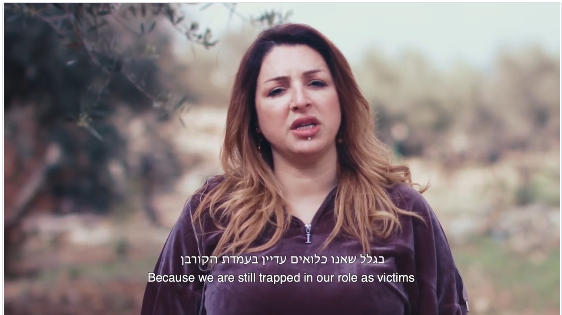
As a retired trauma therapist I cannot ignore a comment made by a Palestinian Arab woman in a promotional video invitation to participate in the May 15th Nakba Day ceremony about which I wrote here. The script has her say:
Because we are still trapped in our role as victims
Palestinian Arabs claim to be victims of Israel as a result of our having won their war of intended extermination against us in 1948. That has become their Nakba, the catastrophe of our humiliation of them — the dhimmi Jews got the better militarily over the mighty Arab Ummah. That is intolerable. And so they continue to try to regain their honour in any way possible — first wars, missiles and terrorism. They are now trying to trick us into believing that they really do want peace with us, to be our partners, and that is the reasoning behind all the so-called co-existence peace NGOs supported by massive0 European funds.
And what has this to do with the Palestinian Arabs being victims of Israel?
First of all, I want it to be clear that I do not support a victimhood olympics. This article does not confront the question of who is the victim of whom. This is only a look into the claim that the Palestinian Arabs are perpetual victims of the Israeli occupier. Those who know me know that I do not see Israel as the occupier. My bias is obviously going to colour the application of my clinical expertise to the issue of Palestinian victimhood and I present my ideas here for the purpose of opening up the nature of the discussion as I reflect on the topic.
We can first look at a situation in which victimization is not questioned: the battered wife or the abused child. Nobody wants the battered wife or the abused child to be trapped in their roles as victims. As a matter of fact, we therapists tell our clients that the best revenge against the perpetrators who violated them is to live good lives. A kind-of “so there!” and thumbing their noses in the perp’s direction whether or not they obtain justice in a court of law.
A lot of therapeutic work goes into coming out from under the control of the perpetrator of physical, sexual or emotional abuse. And none of that involves tempting fate, teasing a hungry lion, or pinching the demon that is not even looking your way. In other words, blowing oneself up in a restaurant in Israel in order to kill families ordering pizza is not something the trauma therapist would suggest the victim do. Sending incendiary kites and missiles over the Gaza border into Israel when Israelis are tending to their agricultural fields, driving to work and sitting down to a meal is not what the trauma therapist would suggest the victim do. Approaching the border crossing between the Palestinian Authority (PA) and Israel wielding a knife or driving a vehicle directly at soldiers at top speed is likewise not what the trauma therapist would suggest the victim do. This is the opposite of building a new life after abuse.
After all, IF — and that is a big if — the Palestinian Arabs were victims of Israeli occupation, once Arafat signed the Oslo Accords in 1995 they cannot claim to be occupied. Oslo created the PA, giving Palestinian Arabs of Judea & Samaria control in Areas A and B over everything but security matters that would endanger Israel, and Israel removed all Jews from Gaza in 2005, handing the keys over to the Arab residents there. This can be compared to the victim of abuse having found safe residence, separate from the perp. Domestic abuse victims, whether minors or adults, would be helped to establish their own lives independent of the former abuser. And they would be helped to understand that revenge fantasies (or real-life acts of revenge as listed above) keep them tied to the perpetrator just as surely as if they were still living under the perp’s roof.
One must also ask about the use of the phrase, “our role as victims”. Why role? I have never heard a trauma survivor say that he or she is trapped in the role of victim. I have heard them say that they want to stop ‘being victims’, not ‘being in the role of’. ‘Role’ suggests script, performance, playing a part, something taken on. In other words, ‘role’ suggests active rather than passive voice. One can step into a role. And this implies that one can also step out of it, of course.
Why is phraseology important?
Because a trauma survivor would say: I want to stop being locked into feeling like a victim. Or: I want to stop behaving like a victim. And these imply taking control over oneself, having agency, taking responsibility for one’s own life by doing something differently: “I will stop being your victim regardless of what you do or say.” This takes an enormous amount of psychological work and is not a ‘role’ easily stepped out of.
Of course, taking responsibility for oneself is only reasonable after the victim is in a safe place. The Oslo Accords and the withdrawal of Israel from Gaza was supposed to accomplish that — provide the safe place within which the Palestinian Arabs could tend to their own needs, build a healthy society and live with dignity and prosperity. Certainly all the funds contributed by the international community should have provided the financial resources to make this possible. However, . . .
The Palestinians do not feel they are in a safe place. Their safe place is all of what is now the State of Israel. Remember, their Nakba is dated from 1948 and not 1967. When they say Israel is occupying Palestinian lands, they mean ALL OF ISRAEL and not just Judea & Samaria and Gaza. Anyone who believes that they want a two-state solution within the borders of 1967 is just not listening to them. How many times must they shout “From the river to the sea, Palestine will be free” before people take them at their word?
Given this reality, they are determined to fight Israel until Israel falls. Just the very existence of the Jewish state is humiliating for them and they will use any means possible to be free of Jewish sovereignty.
And now the ‘role of victim’ makes sense: the Palestinians take on the role of victim because it serves a purpose. By playing victim, they tug on the heartstrings of the Jew who is motivated for change by guilt — in contrast with the Arab honour culture by which motivations for change come from the need to assuage humiliation by getting rid of the source of the humiliation. By playing victim of the Jew, the Palestinian Arabs draw onto their side members of the international community who have no sense of history and want to be seen as the good guys supporting the underdog.
If the purpose of the Palestinians in Palestinian-Israeli co-existence NGOs was truly to live in peace as a successful Palestinian Arab sovereign political entity alongside Israel, they have no need to play the victim. They could long ago have applied the massive resources sent to them from other countries to the building of infrastructure, improving their medical, education and social welfare systems and ensuring employment for their population. This would be parallel to the goal of clinical work with abuse survivors: living a good life.
If, on the other hand, the purpose of the Palestinians in Palestinian-Israeli co-existence NGOs is to defeat Israel and reverse the outcome of the humiliation of the Nakba of 1948, then their ‘victim role’ is a cynical ploy to delegitimize the Jewish state to such an extent that if they were to succeed in defeating Israel one day, the rest of the world would just yawn.
So if the Palestinian Arabs are victims, I contend that they are victims of their own honour-based culture and that is what keeps them trapped and not us. It seems many member states of the great Arab Ummah have begun to see that and are making normalization agreements with Israel, moving forward in the Middle Eastern neighbourhood to a future of new possibilities. What will it take for the Palestinian Arabs to join in?
Feature Image Credit: screenshot from the promo invitation to the 2021 Nakba Day ceremony
Blaming Israeli Occupation Palestinians as victims of Israel
Last modified: May 6, 2021